Showing posts with label Dad. Show all posts

Saturday, June 25, 2022

On Weeding


I learned three lessons from my father the master gardener.  


As I kneel to breathe in the fragrance of rich earth, 

Separating beneficial from non-beneficial,

I hear his wise words.


One:  know well the plants that don’t serve you; dig them up by the roots, so they won’t return to haunt you and your garden.

Two:  shake off every bit of precious earth clinging to a weed’s roots; let the black gold fall back into the rich soil.

Three:  be gentle with the noble earthworm rising briefly from his tunnels; release him to burrow back into the dark and continue his work; he’s the earth’s friend, and yours.


Saturday, June 14, 2014

Weatherwaxisms


On Father's Day eve this year I'm thinking a lot about my Dad.  I miss his unique and eccentric humor, his irreverence, his generosity. On his March 29 birthday in 1986, around the time when Dad retired from RCA, his good friend and co-worker Sandy Lynch compiled this list that always helps me remember him better; some were uttered by him with enthusiasm, others with irony or thinly-veiled sarcasm.

It's like poetry I think.  Those who knew him (or me) or worked with him (or me) or have been lucky enough to join us long ago for one of Mom's Sugar Acres dinners one evening may remember some of these phrases.  There are many parts of life where this vernacular suits, and why not?

Weatherwaxisms*

 Marvelous!
Hell of a plan (deal)
Absolutely ecstatic
You got it, little sister
I'd do it for a dog
You're a hell of a nice lady
You ain't all bad
May I help you?
Appling
Alleying
Sitting up late with sick friends
What is it that you want to have happen?
He/she is a bonafide flibbertygibbet
Poor damned thing
Floundering around aimlessly
I hope so--fervently
Depend on it!
The bean cannery
Right before your horrified eyes
Where will it ever end?
Basically bad
Ya done good!
Oh dear!
Kinda makes your sphincter tighten
Not too shabby
Feigned ardor
Why not?
Fair enough!
A live one
Try not to panic
Suits!
Pitiful
Hybrid vigor
Someone has to serve as a horrible example

*(So you don't forget the vernacular)

Monday, May 12, 2014

There Are Seven Letters in Wavicle


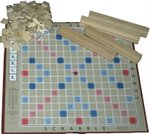
On Mother’s Day yesterday, Caitlin and Shannon cooked me a wonderful dinner:  beet salad, braised chicken with olives and capers, and molten chocolate cake with vanilla ice cream.  And they indulged me by playing four games of Scrabble.  They have both gotten good enough now that they are perfectly capable of trouncing me at the game, and are much less likely to be cowed by my knowing smile when they consider challenging a word I’ve played.

I learned Scrabble during long wintery Indiana evenings from my Mom and Dad, who were both excellent players.  My Dad’s strategy was setting himself up to play bingos (using all 7 tiles at once for 50 extra points).  My Mom’s strategy was short, tight plays leveraging high scoring tiles on triple score squares.  My Dad’s plays opened up the board, and my Mom’s plays closed the board right back up again.  I tripped along behind both of them, grasping at any and all opportunities that presented themselves along the way.  The best part was looking up a word I’d challenged and discovering I was right.

When you look up a word, there’s an irresistible urge to peruse adjacent words in the dictionary (if you love words the way we do).  That’s how Shannon discovered a very good word last night while looking up my play of “waver” (which he was sure had to have an i in it, despite my knowing smile):

Wavicle:  a subatomic particle that can act like both a wave and a particle.

And, as it happens, a 7-letter word.

Monday, December 12, 2011

The Christmas Cactus


A little less than a year ago, I received a Christmas gift. It was a Christmas cactus with a note attached explaining that if I took good care of it, next Christmas it would bloom.  I set it on my desk at work, and as the new year began I made a pledge to myself that despite my decidedly not green thumb, in this case I would channel my father the master gardener and tend lovingly to this cactus, in hopes of seeing the promised Christmas blooms.

The Internet is your friend in cases like this and I found a wealth of advice on how to care for a Christmas cactus, with promises of abundant blooms next holiday season.  I conquered my sense that it would be hopeless (based on the mourned deaths of houseplants past who were unfortunate enough to be under my care).   I acted on faith alone and  entered a repeating note in my computer calendar for each Tuesday morning that said:  “Smile.  And water the Christmas cactus.”  Each Tuesday I did just that.  

A few months ago something told me to move the cactus to a sunnier corner of my office to catch the western sunlight.  In early November the Christmas cactus pushed out many promising buds.  By Thanksgiving, glorious pink blooms emerged.  And they’ve continued to grace my office with their happy color all this holiday season.

I assure you that I am grateful for the many ways this past year I’ve seen proof that faith can work miracles and bring unexpected blessings; I wish both of these for each of you this Christmas season.

Saturday, May 7, 2011

Impostor Syndrome - True Confessions

All my life I’ve suffered from Impostor Syndrome--that persistent certainty that I’m not worthy, that everything I’ve achieved is by chance, an inexplicable twist of fate.  And that surely any moment my fraudulent charade will be uncovered and I will be drummed out of my position in mortal shame.  This self doubt has crippled me at times and generated huge anxiety for me.  So often I’ve felt that I just don’t belong where I am in any way, shape, or form.  According to my research, this is a surprisingly common affliction for women and men.   The prescribed treatments include:
  • attending group therapy with others in the same boat--hearing how common this state of mind is with others who by all outward appearances are deservedly successful
  • imagining what the response would be if you explained your “incompetence” to the supportive people you have “fooled”
  • keeping records of positive feedback received
  • employing positive self talk: “I will do well in this presentation” rather than “I know I'll screw this up somehow”
In my own experience, no amount of self talk has been fully successful in eradicating this feeling, but awareness of it has helped me to stay mindful of the distorted thoughts around it and able to resist it to some degree.
I do remember a conversation I had with my father about 12 years ago (he of the “Horrible Example” fame) when I told him that I had been promoted.  (I will resist the urge here to itemize all the reasons still lurking in my own head for why this was surely an improbable turn of events).  My father’s reaction to the happy news was sheer, unmitigated disbelief.  I could see it in his eyes and hear it in his tone of voice.  He could not comprehend how it was possible.  I do know that my father loved me very  much--but this reaction was painful for me I must admit, and further contributed to my own doubts about my worthiness. 
In thinking back on it, I think my Dad’s reaction was driven by his own negative world view--the self doubt that tortured him all of his work life and caused him huge suffering. 
I remember once in a therapy session (oh, yes, I know from therapy) with a male grad student when I was in my 20’s being called on my “dumb blonde act”--it was a pretty crude and roughly handled confrontation but I’ve never forgotten it and eventually I came to understand what he was driving at.   He said, “You’re just a little cream puff, aren’t you?”
Understanding all of this, today I’m able to let go of the hurt and feel compassion for my father’s past suffering, and the suffering of all who feel like impostors, who have the excruciating sense of unbelonging that can make life such a grind.  

So--for all those fellow suffers who may be reading this and looking for a solution--please look objectively at the evidence, and then choose to believe in yourself.  You are not perfect, but your achievements are real and deserve your recognition and self love.  
Comments appreciated (but I’m determined not to think less of myself if there are none).   Dear, dear.  What a piece of work I am...

Monday, September 13, 2010

Pay No Attention to That Man Behind the Curtain

One of the prime goals of parenting is to become utterly dispensable—to end up with kids who are independent and confident and who fearlessly question authority, including yours.  And an inevitable step on this path involves having your own kids realize your utter fallibility---the terrible truth that you are sometimes (may chance oftimes) dead wrong.

I’ve been thinking again (with love) about my own father, a strong personality and a man who did not easily admit error.  When he got an idea in his head it was almost impossible to change his thinking.  Even in my thirties I still avoided crossing him and put up with various eccentric and ill-advised behaviors from him rather than take that one giant step.
 
I’ve also been thinking about my ongoing battle with the voice in my head that relentlessly reminds me I don’t know what I’m doing, I’m an impostor, a failure, yada yada yada.  I recall the day when I proudly told my father I’d been promoted to director at work.  His initial reaction was undisguised disbelief.  He could not accept that I had managed to get this promotion or that I would be able to do the job without failing.

Now, many years later, it occurs to me that the voice in my head questioning the validity of every move I make is my father’s voice:  The Great and Powerful Oz.  And the terrible truth is that there was only a man behind the curtain, a man who was sometimes dead wrong himself, and man who was insecure in his own life and work, damaged by his own father’s disappointments and held back also by the culture of his time which had no room for the idea of a woman like me rising to such a role.

It’s a shock for a kid to finally admit that the parents are human.  Much as it was a shock for Dorothy and her companions to discover that the Wizard of Oz was not so great and powerful after all and they were going to have to find their own solutions to their various problems.  Here's hoping I applied some of what I learned to my own parenting role and to some decent degree restrained myself from excessive hovering, questioning, doubting and dominating.  I hope I’m doing a good job of letting my kids go, letting them rise to their individual occasions, allowing them to seize their autonomy and independence sooner rather than later.  We're not in Kansas anymore.

Sunday, July 18, 2010

Finding My Voice

                                                 Maggie Kuhn
  
After a long blog drought it struck me on a hike today that what I wanted to write about was finding my voice.  Have I finally found my voice after these many years, or not?  And what does that really mean?  To me it means speaking the truth out loud, clearly, kindly, rather than “stifling myself” constantly.  I stifle myself because of fear—fear of rejection, of authority, of dismissal, of my own sense of worthlessness.

I think finding my voice is not a one-time achievement but an ongoing quest.  I’ve won some battles in this respect but I’ve not won the war, since I often still have to drag myself kicking and screaming to the point where I’ll speak up even when it is absolutely warranted.  Part of me firmly believes that if I actually spoke my mind clearly, honestly and kindly at every opportunity that there might be such a radical change in my life that it would become unrecognizable.  Often it seems ever so much safer to be satisfied with the sounds of silence (Paul Simon had much to say on this topic).

But more and more I’m noticing physical reactions to my forced silences that might be strong hints that I really must speak out more—reactions like insomnia-producing pain from my jaws due to the clenching and grinding I’m unconsciously doing day and night. 

A wise woman asked me recently if I was singing these days.  I am not—even though the songs and their lyrics were always a source of joy and a way I could express deep ideas and emotions in my life no matter what was going on.  So the other night I got out the songbooks, pulled up a chair on the back porch, and told myself I only had to sing three songs and then I could quit if I wanted.  Of course, I sang many, many more—folks songs, spirituals, Leonard Cohen, James Taylor, John Prine.  It felt good.

At work and in my personal life, I’ve often kept my silence rather than be shut down or dismissed.  I think it’s dismissal that’s most painful; it feeds into my thought patterns about losing another person’s love or esteem.  But in my saner moments I know that someone else’s dismissal of me or my ideas is often much more about them than it is about me.
 
When I was young, my father (who I loved dearly) had particularly strong ideas about a child’s behavior.  A child was to be obedient (even though he himself was not in his own childhood, as his stories revealed).  Above all, a child should not “talk back,” but should show respect for her parents.  At times I was chastised for talking back when, in truth, I had no idea that I was guilty of this nefarious and disrespectful deed.  If I did talk back there were usually consequences that to me seemed devastating—mainly "the look" or angry yelling.  I’ve never been able to tolerate being yelled at without becoming incredibly upset about it—and so I’ve developed a variety of techniques for avoiding yelling and conflict of any sort. 

Many of these techniques can be used constructively—diplomacy, fairness, kindness, strong listening skills, excellent verbal skills, empathy.  But in the end it is only with great willpower that I’ve steeled myself over the years to “talk back” to those who have power over me.  I have to overcome a myriad of unpleasant physical reactions, including tears, trembling, a shaky voice, clamminess, hot flashes and a sinking stomach.  Not to mention the catastrophic mental responses like fear that I will lose the love or esteem of the person I’m confronting, questions about how important this issue really is (when weighed against my very survival), questions about whether I am perhaps dead wrong about this particular issue after all, and fear that speaking up at this juncture will irrevocably destroy the relationship and the person I’m confronting will lose respect for me or never speak to me again.  To someone who is not familiar with this kind of conflict avoidance, these fears must seem incredibly neurotic.

The interesting thing is that often when I finally force myself to have a conversation with the person in question I find that they have a perfectly reasonable response, or at least a response that does not result in the end of the world as I know it.  Of course, this isn’t always the case, and sometimes I have battles that leave me the worse for wear or that lead to more trouble for me.  But even then I usually feel as though they were battles worth fighting in the end—words worth saying for my own self respect. One of the first confrontations of this sort I remember daring to have in my life was, not surprisingly, with my father.

I was around 21.  My father had decided he didn’t want to “subsidize” my “shacking up” with M any longer.  I was finishing school and my parents were still paying some of the expenses, although I had a job.  I was living with M (we would not be married until many years later) and we were absolutely in love.  We are still together today, 39 years later.  Despite all my efforts to avoid confrontation on this, it was clear that I had to stand up to my father.  I was shaking so hard I could barely speak, even though it was a hot summer night on the deck looking out on the deep green, firefly-lit Indiana woods.  My mother fluttered around in the background like a firefly herself as the confrontation became more heated.  I had learned many of my confrontation avoidance techniques at my mother’s feet and I realize now she might have feared she would lose me somehow if the confrontation continued.  But I gathered together every inch of courage I had and told my father that if he was suggesting I choose, the choice would not be in his favor, and that I would support myself from now on in order to remove money from the equation.  The consequence:  voices were raised but the world did not end, and over time my father came to respect, trust and love M.

Many confrontations have happened since then—usually with far more angst beforehand than they deserved and with much better outcomes than I had expected.  And so, I have found my voice—I just have to keep finding the courage to use it.


People talking without speaking
People hearing without listening
People writing songs that voices never share
And no one dared
Disturb the sound of silence
                                                Paul Simon

Do you have a story to tell about finding your own voice?

Sunday, February 7, 2010

Sisters of Mercy

A few weeks ago my husband, daughter and I spent a weekend sitting with my husband’s dying mother Jacki; she passed away just a few days after we returned home.

In a tiny Ohio apartment in the coldest days of January, her husband and many family members surrounded her hospital bed, offering what each of them could in love and comfort, seeking ways to say good-bye. The five stages of dying and loss played and replayed themselves not necessarily in neat order, with everything from anger to denial (“I am not dying!”) to acceptance and surrender. I struggled to find ways to respect her experience and her needs as she drifted further and further away hoping my own family would do the same for me one day.

The experience evoked memories in me of other losses including my last days with my father, sitting by his hospital bed feeling as helpless as hell, wishing with all my heart that I could somehow halt the relentless failure of each organ in turn, the inevitability of a life slipping away.

“There’s nothing you can do for me, kid,” he said at one point as we shared an orange together. I remembered him years before offering my grandfather sections of orange in the convalescent home during the last few months of grandfather’s life.

“I know there's nothing I can do—but I wish there were.  I wish there were,” I replied.

And what do you do for the dying in those last hours or days when they can move so swiftly among flashes of fear, denial, regret, pain, acceptance, love, anger? Surrounding her bed, each of us did what we could. Her daughter and her friend stayed there and provided care day and night, her sons were there for her in every way they could be, each of the grandchildren did their best, her husband sat by her bed and asked if there was anything she needed.

I rubbed Jacki’s feet and legs a couple of times, for as long as she seemed to want me to, and was rewarded with the smallest of smiles as she gazed into my eyes. I told her we all loved her. I asked her questions about her distant past, trying to focus on the good memories. I helped her with a few sips of water, took my turn giving her meds mixed with yoghurt, distracted her from her discomfort while the hospice nurse bathed her by talking steadily of those sun-filled summer days at a Florida beach years ago when she took the grandkids for a few nights and gave my husband and me some delightful alone time that meant the world to us at the time. I thanked her once again for that kindness.

My sister-in-law and I sang Cohen’s “Sisters of Mercy” together for her as I played the guitar.

Oh the Sisters of Mercy they are not departed or gone.
They were waiting for me when I thought that I just can’t go on.
And they brought me their comfort and later they brought me their song.
I hope you run into them, you who’ve been traveling so long...

We all sang another song she remembered and liked that the family used to sing together: “Abilene.”

Everybody did everything they could to provide love and comfort at every opportunity and yet in the end of course nothing could halt the process, and a few days after we left, she was gone. I am, as I always am after a death in the family, with the feeling that somehow I could have done more, or done things differently--the familiar regret that always consumes me when a family member is gone forever and I’ll never hear that voice again.

Farewell, Jacki.