Grieving in Place
Searching for light in this beloved face,
And well-remembered passion
Lost in the present
The presence of light
Still under the surface
Still sending small glimmers upward
Sometimes these storm clouds
Float far enough away
And a small patch of blue smiles,
Or a sunset glows in orange and red
Fading so breathtakingly soon back into deep purple
Then midnight blue and gray once more.
Searching for light in this beloved face
Grieving in place
Thursday, July 10, 2014
Saturday, June 14, 2014
Weatherwaxisms
On Father's Day eve this year I'm thinking a lot about my
Dad. I miss his unique and eccentric
humor, his irreverence, his generosity. On his March 29 birthday in 1986,
around the time when Dad retired from RCA, his good friend and co-worker Sandy
Lynch compiled this list that always helps me remember him better; some were
uttered by him with enthusiasm, others with irony or thinly-veiled sarcasm.
It's like poetry I think.
Those who knew him (or me) or worked with him (or me) or have been
lucky enough to join us long ago for one of Mom's Sugar Acres dinners one
evening may remember some of these phrases.
There are many parts of life where this vernacular suits, and why not?
Weatherwaxisms*
Marvelous!
Hell of a plan (deal)
Absolutely ecstatic
You got it, little sister
I'd do it for a dog
You're a hell of a nice lady
You ain't all bad
May I help you?
Appling
Alleying
Sitting up late with sick friends
What is it that you want to have happen?
He/she is a bonafide flibbertygibbet
Poor damned thing
Floundering around aimlessly
I hope so--fervently
Depend on it!
The bean cannery
Right before your horrified eyes
Where will it ever end?
Basically bad
Ya done good!
Oh dear!
Kinda makes your sphincter tighten
Not too shabby
Feigned ardor
Why not?
Fair enough!
A live one
Try not to panic
Suits!
Pitiful
Hybrid vigor
Someone has to serve as a horrible example
*(So you don't forget the vernacular)
Saturday, May 24, 2014
Curiouser and Curiouser
| Fern Canyon, Boulder CO |
"Life is meant to be lived, and curiosity must be kept alive. One must never, for whatever reason, turn his back on life." - Eleanor RooseveltFor those of us still curious about life, the Internet is one fine invention because its hyperlink structure allows you to wander from one related (or not so related) idea to the next so very easily. It's like taking a hike in a vast forest and being presented with many twisty passages, all different. Exciting to explore, easy to get lost and follow a path that seems to dwindle to nothing. But even at that point of nothingness, new rabbit holes pop up along with new ideas if you have enough curiosity to take the plunge. To me, curiosity is essential to joy in my life; however, I also want to be someone who can provide some guideposts along the path.
Recently, a group of people I worked closely with for many years before my retirement in February were laid off, after two decades or more of faithful service to the company throughout its various transformations, iterations and new-old strategies. This latest development was described by the company's leaders in Orwellian newspeak as "simplification."
I've only been laid off once several years ago, but the experience is still vivid in my memory: the initial feeling of being jettisoned out of the spacecraft with limited oxygen in the tank, the processing of the various stages of grief, the questioning of self worth, the terror at the unknown. So my heart has been with these friends as they each travel their new paths--some elated, some scared, some elated and scared, some just thinking they'll take the summer off and then decide what to do, some kicking into courageous high gear to finally fulfill that beautiful writing project or Caribbean dream they've been envisioning these many years.
After talking to some of them, I'm not heartbroken any longer. I'm thrilled for them. Yes, yes, yes, as always there are practical considerations. If they asked me, I would tell them there are many paths in the forest, and curiosity is the best gift. Don't deny those urges to explore the less traveled side paths. As has just been revealed once again, you never know what you'll encounter on the next steps in the journey and that's what keeps it interesting.
Monday, May 12, 2014
There Are Seven Letters in Wavicle
On Mother’s Day yesterday,
Caitlin and Shannon cooked me a wonderful dinner: beet salad, braised chicken with olives and
capers, and molten chocolate cake with vanilla ice cream. And
they indulged me by playing four
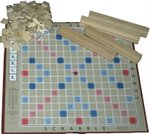
games of Scrabble. They have both gotten
good enough now that they are perfectly capable of trouncing me at the game,
and are much less likely to be cowed by my knowing smile when they consider challenging
a word I’ve played.
I learned Scrabble during
long wintery Indiana evenings from my Mom and Dad, who were both excellent
players. My Dad’s strategy was setting
himself up to play bingos (using all 7 tiles at once for 50 extra points). My Mom’s strategy was short, tight plays
leveraging high scoring tiles on triple score squares. My Dad’s plays opened up the board, and my
Mom’s plays closed the board right back up again. I tripped along behind both of them, grasping
at any and all opportunities that presented themselves along the way. The best part was looking up a word I’d
challenged and discovering I was right.
When you look up a word,
there’s an irresistible urge to peruse adjacent words in the dictionary (if you
love words the way we do). That’s how
Shannon discovered a very good word last night while looking up my play of “waver”
(which he was sure had to have an i in it, despite my knowing smile):
Wavicle: a subatomic particle that can act like both a
wave and a particle.
And, as it happens, a 7-letter word.
Friday, April 25, 2014
Eating Artichokes
The other day artichokes were on sale at King Soopers, 2 for
$3. I bought two and took them home to
cook the way Mom used to cook them: cut
off the tough stems; put them in a pot with salted water to cover (although the
little dudes float, so covering them is an impossible quest); add chopped
garlic (Mom used garlic salt instead); and then boil them to within an inch of
their lives, for around 40 minutes. Chill them in the fridge for at least a
day, then eat them cold for lunch with plenty of real, salty-lemony mayonnaise
(Hellman's, not that sickly sweet Miracle Whip crap).
Eating an artichoke is a unique experience. The boiling gives them a dark army green
color. You set them on a large plate so
you have room for the discarded leaves, with plenty of mayo on the side, then
you add another spoonful of mayo for good measure. Peel off one leaf at a time,
dip the non-pointy end in just enough mayo to make it tasty, then scrape the
soft green stuff into your mouth with your lower teeth. Artichokes have kind of a vegetably,
mayonnaisy flavor (some say they are merely an excuse for eating mayo--I've
been known to eat cold leftover cooked broccoli the same way).
As you remove the leaves one by one, eventually you unearth a
cluster of remarkably lethal-looking leaves in the center with pointy purple
ends that can actually prick you if you're not careful. You gather these together and pull them out
of the remaining artichoke heart in furry little tufts, and then you're left
with what my mother called "a delicacy," the artichoke heart. And if you've been careful with your
mayonnaise you have enough left to do it justice.
Artichokes remind me of my mother, who ate them with
matter-of-fact gusto as if they didn't look like small green creatures from the
planet Vegeton. Sometimes I was allowed
to pack one for my school lunch. How the
mayonnaise was preserved in my un-refrigerated little lunchbox so that it didn't
kill me off with salmonella by the time lunch rolled around I'm not sure. I do know that the other kids at my grade
school, their lunch trays loaded with peanut butter and jelly sandwiches and
mystery meat, would gaze at me with a mixture of revulsion and admiration while I ate the artichoke in the time-honored
fashion--just one of many things back then that earned me and my family an
eccentric reputation in a small southern Indiana town in the early 60's.
Thursday, April 17, 2014
Coaching My Inner Critic
“Perfectionism
is the voice of the oppressor, the enemy of the people. It will keep you
cramped and insane your whole life, and it is the main obstacle between you and
a shitty first draft. I think perfectionism is based on the obsessive belief
that if you run carefully enough, hitting each stepping-stone just right, you
won't have to die. The truth is that you will die anyway and that a lot of
people who aren't even looking at their feet are going to do a whole lot better
than you, and have a lot more fun while they're doing it.”
― Anne
Lamott, Bird by Bird: Some Instructions on Writing and Life
As I struggle to produce even the first step per Lamott (a shitty first draft), a friend advises me: "Lose the inner critic." My sister teaches creativity workshops in which she strongly encourages her students to "dare to suck." I was once in an improv jam session with her
in which the primary theme, sung and danced with a blues motif, was all about
daring to suck.
All the self help books in the world tell you to be aware of the
voice of your inner critic so you won't inadvertently censor your every
move. In fact, that's not enough. I think you have to be acutely aware, and
then write down every word verbatim for awhile, every word that nasty little
bastard is whispering in your ear.
"No sense in even starting to write that
blog/novel/poem--you know it won't be any good."
"No one will read it"
"You have nothing interesting to say."
"It's a waste of time!"
Then close your eyes and perhaps imagine that a school teacher
has said those things to your kid. Now do you feel your talons
unsheathing, ready to fight back?
Since the inner critic is really a part of me and probably does
have some useful insights, I'm wondering if I can coach him to be more
constructive. If I model the
constructive approach for him, next time the negativity sets in, it might go something
like this:
My inner critic: You're just not creative enough to come up with new ideas.
Me: You know, we need to
talk. You're not helping.
IC: Hey, it's tough
love. Somebody has to keep you honest.
Me: All this negative talk
just shuts me down creatively and I can't even muster up the guts to suck.
IC: Well, as I was
telling another one of my clients...
Me: Clients?! You harangue other people this way
too?
IC: Sure--my genius is
relevant everywhere. This other client is in an African dance class. She just
loves this class and has gotten some compliments about her dancing. At the end
of each session, the drummers drum wildly and a dance circle forms where one dancer
at a time can prance to the center and show her best moves. My client would just love to enter the dance
circle. So far I've protected her from
making a fool out of herself by sucking. She goes home each week after class sad, but safe
and sound, unembarrassed.
IC: Not worth the
risk. She's not perfect, you know. She'd just disappoint herself and everybody
else and we can't have that happen.
Me: Look, I don't know
about the dancer, but I need a change.
From now on, if you can't say something constructive, don't say anything
at all. Otherwise I'm going to switch
channels and stop listening to you altogether, got it?
IC: You're a coward! You can't take the truth. If you're that
sensitive, you'll never get anywhere anyway.
Me: There you go
again! I'm shutting you down. Every time you say something negative I'm
going to block it, and think of trees instead, since I'm quite fond of
trees. They're beautiful and they
produce oxygen, essential for breathing...
IC: Trees! What a stupid...
Me: ...Oak. Pine.
If: ...stupid...
Me: Sycamore. Sassafras.
Breathe.
IC:
Me: You know, I'll take
constructive criticism...
IC: You wouldn't know
constructive criticism if it bit you in
the...mmf. Bmf.
Me: Look, since you're part of
me, we both have my best interests at heart, right?
IC: Right, but you don't
want your blog to suck, right?
Me: True. But right now I'm working on what Anne Lamott
calls a "shitty first draft" for my blog. Just getting my ideas down
in some form, knowing nobody will ever read it in this form. It doesn't have to be perfect. Really.
If you have something helpful to say, I might let you help me edit it
later.
IC: You know you
get wordy.
Me: I know. We can polish it together. Later.
Once the first draft is done.
IC: Okay, if you ever
conquer your laziness long enough to finish the boring first dr... Mmf.
Bmf.
Me: ....Maple. Boab.
Eucalyptus. Ginkgo. Boojum. Avoid using words like
lazy and boring.
IC: You said shitty.
Me: I'm allowed to call it a shitty first
draft--you're not.
IC: Looks like you've got
a good start. As soon as you finish the
first draft, which I'm confident you will, I'm convinced it'll meet your shitty
standards and I'll be right here, ready to help.
Me: Better. You can do this. Meanwhile, go tell that other client of yours
that she's a beautiful dancer who deserves her spot in the sun, and in
the dance circle.
Sunday, April 13, 2014
The Wisdom of Uncertainty and "The Circle"
Happily, my recent retirement frees me to do some things I've
always wanted to do, like attending last week's Conference on World Affairs (CWA) at CU in Boulder, the renowned “conference on everything conceivable.”
I was inspired by one standing room only session entitled
"The Wisdom of Uncertainty."
The panelists did a great job of outlining the human dilemma in which we
dislike uncertainty and take Herculean measures to avoid it, even though
"not knowing" and questioning the basic assumptions we’re
constantly making can be the very best path to renewed creativity, innovation,
and growth. They also pointed out that
every amazing new breakthrough in science occurs when someone decides that they
don’t
know something, tosses out assumptions, and sets out to learn the truth. One panelist asked the audience who had seen
a sunset – and then explained that none of us had, since the sun doesn’t
set, although the phenomenon that looks like the sun setting was only recently
understood correctly after the "certainty" that the sun revolves around the earth was questioned.
The panelists also pointed out that there's a difference between
confidence and absolute certainty. For
example, you can be confident that your efforts to write a blog will bear
fruit, despite a case of writer's block from hell, even though you're not
certain exactly what you'll come up with or whether the topic will remotely
match your initial concept. Uncertainty
can pave the way toward new connections and ideas.
Speaking of “not knowing,” I just finished an
unsettling novel by David Eggers called "The Circle" about a social
media company in Silicon Valley that has absorbed all its relatively feeble predecessors
(Facebook, Google) and metastasized into a behemoth organization with leaders Quite
Certain that their innovations can solve all the problems of the world once
they are able to “close the circle” by collecting and tying together all
information and making it fully available and transparent to everyone for the greater
good of humanity. Thus, employees are
encouraged and ultimately coerced where necessary to constantly share their perceptions
and feelings. In fact, privacy is considered insubordinate since it robs everyone
of the information and transparency needed to resolve problems and prevent
wrong doing.
The novel’s protagonist is new hire Mae, a young woman the company
immediately sets out to indoctrinate and who at one point is even led during a
company-wide meeting to publicly utter the 1984-style maxims of The Circle:
SECRETS ARE LIES
SHARING IS CARING
PRIVACY IS THEFT
Mae is relentlessly pressured to share more and more of her most
private thoughts and experiences, from intimate encounters to medical
data. At a couple of points I felt
claustrophobic enough to put the book down and get a breath of fresh air,
wishing Mae could do the same.
Kayaking on the bay, Mae escapes a couple of times to that most
precious source of centering, solitude and peace, nature. She paddles to an island, climbs a tree,
wonders about the content of a bird’s nest and decides she cannot know
this information without disturbing the nest and its inhabitants and so
foregoes the knowledge. For a short while she remembers to breathe and
acknowledges the value in "not knowing" what's in the nest or below
her in the dark depths of the bay as she kayaks back to shore.
But she quickly gets in trouble at work for this, since being
alone and not sharing information about her experience are viewed to be willful
and selfish acts, unsupportive of the world view The Circle's leadership is so
certain is correct.
I can recall a few times in my own career when I saw the same
level of arrogant, absolute certainty from leaders, feeling both amazed and
disquieted by it. There is a wisdom in
uncertainty, in seeing the world from constantly fresh perspectives and questioning
self-limiting assumptions. In the end I would rather lean that way than walk
around absolutely certain about life, the universe and everything.
Also, it occurs to me that perhaps I’ve been way too
lackadaisical up to this point about the question of privacy. When carried to the extreme where it's
socially unacceptable not to constantly share, the value of what is shared
seems diminished--better to live with a greater degree of uncertainty.
Subscribe to:
Posts (Atom)