Monday, November 5, 2007

The Great Wild Goose Pagoda - Xi'an, China

Another place I had a chance to visit while in Xi’an, China recently was the Great Wild Goose Pagoda. It is surrounded by beautiful gardens and many statues of Buddha. It was built in 652 during China’s Tang Dynasty.

Two white stone lions guarded the entrance to the Pagoda. In the garden nearby was a large golden Buddha and people were waiting in line to kneel before the statue. In a building nearby there were many niches with Buddhas deep inside, shining golden or glowing with blue backlight in the darkness, cushions at each station for those who wished to meditate or pay respects.

People were lighting candles and buying incense to light and burn at one spot.

Beautiful and colorful wall decorations and paintings surrounded the niches containing the various Buddha statues, including this one featuring one of my favorite shades of blue. The Great Wild Goose Pagoda was one of the more exotic sights I saw while in China, and I was glad I made it one of my tour stops.

Sunday, November 4, 2007

Imperial Terracotta Warriors - Xi'an

Few people get the opportunity I got this past week. I traveled on business to Xi’an, China and Singapore. My first full day in China was on Sunday so I took a tour.

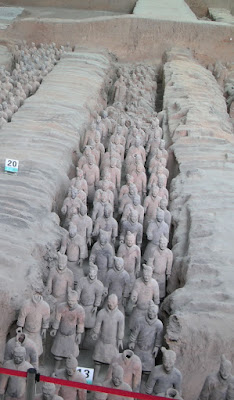
I hired a car to take me about 45 minutes outside the city of of Xi’an to view the world famous 2,200-year-old archaeological dig with, the Imperial Terracotta Warriors. The ancient Chinese emperor Qin Shi Huang, in an elaborate attempt to preserve his soul forever, had over 6,000 warriors made of clay and fired in kilns to guard his tomb. All of them were larger than life size (for China anyway), and each with distinctly different features and postures. Figures for archers, generals, and other soldiers were made, facing to the east, west, north and south, guarding the emperor’s tomb. A separate area for headquarters has those figures facing inward; the theory is they are strategizing their next battle. Horses were also made, some saddled for the soldiers and some to pull chariots. Bronze arrows, shields, horses and chariots were also buried at the site, as well as other artwork including bronze cranes and other water birds.
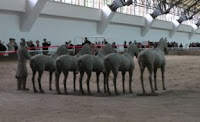
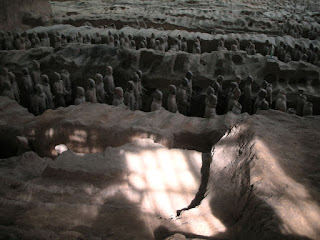
Now the Chinese people are unearthing and painstakingly restoring them. They stand in row upon row in the earthen holes. The original statues had color as well, but the Chinese quickly discovered that once they were unearthed and exposed to the air, the color faded. A display shows what some of them looked like before fading.

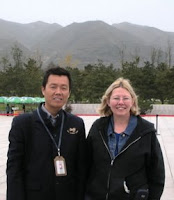
I spent the extra money to hire a Chinese tour guide who spoke English, Liu Hong Jun, and he took me through the beautiful gardens with pomegranate and persimmon trees surrounding the site and to view the three separate excavation pits in various stages of restoration. It was a chilly fall day in China and the air was clearer here than in Xi’an itself which has quite a thick and murky atmosphere, the kind that makes your chest hurt a little bit after awhile.

The first pit was found in 1974 by a farmer named Yang who was working in a field. He or a relative still signs books about the museum to this day in the gift shop. My colleagues at work later told me that according to the story, this farmer had to stop signing books for awhile because the flash from the tourist’s cameras had made him temporarily blind; he seemed fine on the day I paid 150 Yuan to buy a book which he signed for free. I leave to the reader the question of whether this was really the original farmer or a surrogate standing in for the day.

My guide told stories of the many measures the emperor had taken, using concepts of Feng Shui, to align his palace and tomb correctly for best good fortune near the mystical Li Mountain. Emperor Qin began the work of his mausoleum when he was 13 years old and it took 38 years, using up to 720,000 conscripts at one point. He had the tomb builders buried alive to ensure that the location of the tomb was kept secret. The Qin Dynasty was a relatively short, cruel one and he was actually emperor of China for only fifteen years. His mausoleum, built of earth and wood with grass mats covering the tomb, was burned by a rival, destroying or damaging many of the relics. Emperor Qin was no friend to Confucians, often having them killed. In the end his efforts to live forever were futile. Confucius said:
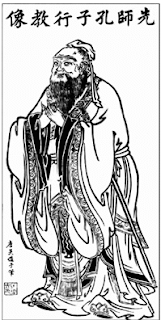
"All men desire wealth and high status, but if these cannot be achieved in accordance with the moral law, then they should not be accepted. All men hate poverty and low status, but if these cannot be avoided in accordance with the moral law, then they should be accepted. How can anyone who departs from virtue be considered a Chun-Tzu? A Chun-Tzu never departs from virtue, not even for the time of a single meal. When he acts in haste, he acts according to virtue. In times of trouble, he acts according to virtue."

Saturday, October 13, 2007

Autumn in Boulder

One of the most beautiful times of year in Boulder is fall. It is mid-October—we took a walk along Mapleton and nearby streets this morning. Even with a cloudy sky there was a certain mysterious, luminous quality to the leaves, especially the orange and red ones. For some reason, despite a couple of freezing nights, many flowers are still going strong and this is heartening. New buds are even forming. Winter is not here yet – it is a beautiful autumn. We ended up circling around to a Pearl Street coffee shop for a little journal writing, or “noodling” as M calls it. A couple of gray- bearded homeless guys sat out front on the low brick walls surrounding the flowerbeds, talking, smoking and reading the newspaper. One of the regulars, the skinny guy with the pirate hat, eye patch, and skull and crossbones flag who often sits with a small entourage at this spot, was not in evidence although his cart and flag were there. It is still reasonably good weather for these guys and they are probably managing okay for now – later in the fall and winter it will be a lot harder to see them outside in all kinds of weather.

Sunday, September 23, 2007

Lost Lake Hike

Caitlin suggested a hike up to see the aspens, and Saturday morning she, Shannon and I headed up to Eldora. We took Hessie Townsite Trail to Devil’s Thumb and on up to Lost Lake. The aspens were gloriously gold against the deep green pine and it smelled wonderful.

I told the kids about the last time I had headed up this trail with the two of them; Shannon was riding in a backpack on my back, and Caitlin was still cozy inside me, waiting to be born about a month later. I was hiking with my brother and my husband and people would pass by and look at us curiously, seeing a small very pregnant woman with a kid on her back and two big men hiking beside her, kid free. But Shannon wasn’t comfortable on any back but mine, and so it goes. The picture is from a slightly earlier time, but you get the idea.

It was a glorious blue sky September day in Colorado, and we laughed and talked a lot all the way up, past a rushing stream, big rocks, and many dogs enjoying the trail and especially Lost Lake itself as they sloshed around the banks and fetched sticks thrown out into the lake.

I was glad my kids enjoy my company on a hike like this, and grateful to Caitlin for coming up with the idea. Also I was filled with joy to see again how well Caitlin and Shannon get along with each other and how much they enjoy each other's company.

They are friends, and that is not always the case with brothers and sisters. It is a wonderful memory.

Wednesday, September 5, 2007

Mitchell to Blue Lake Trail

Yesterday morning Mark and I drove up to Brainard and hiked Mitchell Lake Trail most of the way to Blue Lake. As we had hoped there were plenty of parking places the day after the holiday on a weekday.

It turns out Mark has very fond memories of this trail, recalling a hike he took on it with his Dad and Shannon, when Shannon was about seven years old. He remembers there was a snowfield near the top and the three of them had a snowball fight in summer – a happy memory.

We let two pleasant looking yet chattering women past us, and then headed up the pine-shaded trail, the light dappling the rocks, ferns and fallen logs in that way I love. I took lots of pictures. The smell of pine was deep and delicious. We stopped at one point and stood very still, listening to the peaceful silence in a moment of Zen. Only the rush of wind through the trees and the sound of running water could be heard.

Further up, Mitchell Lake was in a tranquil state, the water glimmering shades of brown, gray and green. As we moved above tree line we could look down below to a series of small lakes and rock formations, while above the clouds moved and reformed and grew as though alive in the blue sky overhead.

We made it far enough to sit on a promontory overlooking walls of talus and a fall of water staining the otherwise sandy-yellow rocks a darker gray. The water tumbled into a small stream below lined with bright green plants and a few alpine flowers. Mark spotted a fat marmot who, startled to see us, hustled away up the talus and was quickly camouflaged by the surrounding terrain. That’s the first time we’ve seen a marmot in the mountains in perhaps fifteen years.

We ate our ham and cheese sandwiches and rested awhile, then headed back down, our bodies protesting the long hike back over rough rocks much of the way. It was a wonderful day, and Mark asked me to send the best pictures to his Dad to help him remember that other happy hike long ago.

Monday, September 3, 2007

Summer Flowers

As the summer ends I want to hold fast to the memory of the beautiful flowers Mark's green thumb has kept blooming in our yard. They have given both him and me hours of joy, even though they are a lot of work. By sharing them here, I give a little past homage to my father's practice of sharing his Indiana garden flowers with friends, neighbors and nursing homes. Even though Mark and I don't pick the flowers and deliver them to others, we share them with the neighborhood and I now share them here.

There can be something calming about watering the garden and keeping it groomed, and at the same time it is a chore that calls to be done over and over again in the hot, dry Colorado summer in order not to lose the flowers to the heat, a chore that makes us ready for Autumn when it comes.

There is an essence of healing in flowers. Mark has created a small garden in the front yard we call the "Yellow Garden," which is one of the first sights I admire in the morning, and one of the first I am glad to see when I return home from work each evening. It always cheers me up.

It has several varieties of yellow flowers including a yellow snapdragon that brings back the memory of my grandfather first showing me how the snapdragon got its name, by holding the flower and squeezing the little jaws to open and close them like a little dragon.

Each year Mark says it was too much work; he will scale back or discontinue the gardening next year! And each year spring comes around and he has new ideas for expanding the yellow garden, or planting more morning glories.

Saturday, September 1, 2007

Breathe

I have been working on taking deep breaths that fill my lungs and push out my belly, and then holding for a second and releasing the air in a big whoosh through my mouth. As I practice this, I sometimes relax into a state of well being, and often I yawn. Perhaps it's my imagination, but it seems occasionally I am rewarded with the tiniest rush of endorphin. I think this means I'm doing it right. I practice this several times a day, when walking, stretching, driving, sitting at the computer or bouncing on the ball I now have in my office.

I remember my Dad used to hold his breath, then release it in a rush through pursed lips: pffffff. He did it when he was working hard, concentrating on a delicate task of some sort, or otherwise working with his hands. I used to think he was just forgetting to breath, holding his breath as he concentrated and releasing it all at once when he remembered. However, Dad was stationed in France during World War II and one of his jobs was to defuse bombs. He rarely discussed this so I can only speculate: Could it be that way back then, at age 20, he had instinctively learned a way to breath that was calming and head-clearing, producing focus and mindfulness for a dangerous and delicate task?

Eckhart Tolle had this to say in "A New Earth:
"Someone recently showed me the annual prospectus for a large spiritual organization. When I looked through it, I was impressed by the wide choice of interesting seminars and workshops. It reminded me of a smorgasbord...The person asked me whether I could recommend one or two courses. "I don't know," I said. "They all look so interesting. But I do know this," I added. "Be aware of your breathing as often as you are able, whenever you remember. Do that for one year, and it will be more powerfully transformative than attending all of these courses. And it's free."

He also says:
...Being aware of your breath forces you into the present moment--the key to all inner transformation. Whenever you are conscious of your breath, you are absolutely present. You may also notice that you cannot think and be aware of your breathing. Conscious breathing stops your mind--but you are fully awake and highly alert."
So simple a concept: Remember to Breath.