Saturday, May 3, 2008

A Passage to India

I had a surreal computing experience a few mornings ago. My Norton Internet Security software was having the same trouble it had once before where the “Live Update” feature automatically downloads all the appropriate updates including the latest virus definitions, but then can’t seem to recognize that it's done this, and insists on starting the process over and over again - while annoyingly warning me that I am “unprotected.”

Oh, yes, those of you have Macs are laughing smugly right now since you didn’t spent your Saturday morning trying to fix this problem (or another one I still have and am too lazy to fix where Micro$oft’s Auto Update keeps trying over and over again to update .Net on my PC each time I shut it down (all the more enfuriating when, as far as I can tell, I have no earthly need for .Net anyway).

I laugh out loud at Apples “Mac and PC” commercials on TV, where the Bill Gates look-alike is repeatedly embarrassed in front of the young and perplexed Mac character. A recent one has Bill in the cobra position on a yoga mat, working off his “stressful year with Vista” aided by a young and lovely yoga instructor who is gently banging a gong at each salient point, while “Mac” observes bemusedly on the sidelines. “Breathe out and expel all that Vista bad energy…”

Eventually the once serene yoga instructor becomes distraught over Vista’s negative impact on her Yoga studio billing software and bangs the gong so hard that it falls over in a loud clatter. Then she rises gracefully, as yoga instructors are able to do, and stomps off while Mac looks on, shaking his head. The PC bashing is well deserved – but I have a PC at work and I don’t really want to switch back and forth between two different operating systems each day. Anyway, I digress.

To solve the more pressing anti-virus software problem I went to Symantic’s website seeking help, and decided to try the real-time 7x24 tech support chat and PC Rescue feature. It wasn’t long before I was in chat mode with “Saravanan,” who I am 99% sure was working from India at what would have been about 10:00 pm local time there. After downloading some “PC Rescue” software, Saravanan took control of my PC with my queasily extended permission, and soon the mouse pointer was moving by itself in ghostly fashion on my screen, working to fix the problem. A reboot was required and then some registry magic, the running of an auto fix program and the restarting of a certain Windows service that had mysteriously been stopped – at which point the problem seemed to be fixed (and has not returned since). Saravanan said that if the problem recurred I should contact them and get an upgrade to the 2008 version.

This was the global economy in action for sure – somebody on the other side of the world fixed my PC. And somebody on the other side of the world is earning a good living doing that. There are many ways in which the Internet is a bane and a curse – but there are also many ways in which the Internet brings miracles into people’s lives. It’s a love-hate thing.

Saturday, April 26, 2008

Digging Up Dead Thyme

Mark mentioned a conversation he had with our next door neighbor Jim while Mark was in the front yard “digging up dead thyme.” We both laughed at the irony of this phrase and agreed it should go in at least one of our journals; he told me that it was a gift to me and I should record it in mine. Why is the phrase so amusing? I suppose because I do spend a good deal of my time (hah!) thinking thinking thinking about past events, losses, things that could have gone better, mistakes and mysteries.

On the other hand, sometimes yard work has to be done to clear out dying vegetation and then it is quite necessary to “dig up dead thyme;” to finally understand what happened long ago and how it is influencing the present dream.

I just finished a book called “Loving What Is,” by Byron Katie, another book about accepting and living in the present. In this book, Katie (as she calls herself) talks about emerging from a deep depression with a sudden understanding of how to do “The Work” to look at the problems of life in a new way. She sums up the work as follows: “Make a judgment, write it down, ask four questions, turn it around.”

I make it sound a little simplistic or a little crazy, but what it does is make you look at a problem that is causing you great unhappiness and see it in a new light. This follows the same path as other approaches such as cognitive behavioral therapy and the Power of Now—the idea is to be mindful of the thinking that is causing suffering and to dispute or counter that thinking. When it works (and I have found that it can work), it can alleviate some of the suffering. It is a focus on the pure reality of now.

Telling someone else about it, however, in the hopes that you might help them alleviate their own suffering, is alas a very different matter and quite difficult to do. A person is not ready for this until they’re ready, and until they’re ready, it sounds off the wall, boring or both. (Hello? Still there?)

What are your experiences with techniques for changing your moods for the better? Feel free to post here. For my other blogs on this topic, see Sanity.

Friday, March 28, 2008

Sunrise in Galveston

We made our way to Galveston Island for a short vacation over Easter. Our balcony looked right out on the gulf and the steady sounds of the surf were soothing to my stressed out ears. We watched the moon rise over the water on the first night, a beautiful sight difficult to capture with a camera, and we saw a sunrise the next morning that was just as beautiful, with the great orange sun lifting liquidly off the surface of the water before rising in a shimmer to light the new day. We soaked luxuriously in the condo hot tub several times, and declared that this might be something we’d enjoy having in our own home.

Galveston Island is an interesting place – culturally diverse with a history. There was a Battle of Galveston during the Civil War because of the importance of port access, and indeed we were able to wander across the island and see the port and the two cruise ships docked there on Sunday – a reminder of a previous trip we’d taken when we cruised down the Mississippi from New Orleans the very last year before Hurricane Katrina nearly destroyed it.

There are nuances of New Orleans in Galveston as well; old mansions, palms and elaborately branched live oak trees, an exotic feel that whispers of Bourbon Street but only the faintest of whispers. In March, the streets were relatively empty and seemed deserted – there was a chill off the ocean and it was not yet time for the crowds and the sunbathers. We walked along the famous Seawall, built after a terrible hurricane in 1900 took the lives of at least 6,000 island people who had no warning and in any case no quick way to escape the big waves—the worst natural disaster in the history of the United States. Three quarters of the buildings in Galveston were destroyed in this hurricane, and the town began building the seawall that now stretches for more than 17 miles along the Galveston coast. One edge of the seawall was a short walk from our condo. In inimitable Texas style, there were no guardrails to protect a heedless tourist from walking or biking right off the edge of the wall with quite a drop to the rocks below. No nanny state here in Texas; just keep your eyes peeled. I pondered the glaring contrasts of a state that could have produced both George W. Bush and Molly Ivins (who had the wit to first call GWB “Shrub” and “Dubya” and who I miss dearly during this election year).

We drove across a causeway to Pelican Island and talked to fishermen on the pier who showed us several whiting they had already caught that morning (too early for speckled trout, they said). Along the road on Pelican Island we encountered a strange sight – a huge burst of flame, emanating significant heat as it shot from its tower, and burning endlessly orange against the blue sky. Quite beautiful in its own way, but also alarming, some kind of burn off of natural gas from an oil derrick we were guessing. A telltale sign across the road proclaimed: Halliburton Corporation. Galveston is unapologetic about the “oil bidness;” a helicopter flew across the ocean and over our condo each day at about the same time, a courier for the offshore oil operations just barely visible by the red lights across the ocean.

We walked both ways along our beach several times during our stay and got a sense for the western, and less crowded, end of the island in an area called Jamaica Beach. We also explored the east end and the town, having Easter breakfast in the elegant Hotel Galvez. Restaurants were scarce on the west end of the island, but on the last night we visited a place called Woody’s with a weatherworn balcony that looked out over wetlands, water birds and the ocean. Woody’s served liquor only, no food, and was probably one of the grungiest dives I have visited in recent memory with a strong biker theme, a quarter pool table with decent cues, and smoking allowed anywhere you damn please. But the people were friendly and the young woman tending bar assured us that we could get food across the street in one of three restaurants, all good. One of these was closed altogether but we managed to make our way to The Captain’s Table where we indulged in fried seafood that neither of our waistlines needed, but why not? We were on vacation.

On our last day we visited Moody Gardens with its pyramids housing an aquarium and a rainforest with parrots. We turned pure tourist at that point and I took several pictures of fauna and flora including quite beautiful tropical birds and orchids. We lunched in the Moody Hotel and Resort where posters proclaimed that, should one wish, one could attend a program called Gospel by the Sea.

We were ready to come home after a few days, appreciative of the change of scene but glad to be back in our little house that now seemed spacious after the condo, and able to dine on food we cook ourselves which, we do say so ourselves, is 99% of the time far superior to anything we find in any restaurant regardless of how much we are willing to pay.

Sunday, March 16, 2008

Bitches Get Stuff Done

Are you wondering what exactly Tina Fey said on Saturday Night Live the other night that made so many women shout, "right on!"? She was doing a commentary on the "News Update" segment and she said this:

Maybe what bothers me most if that people say that Hillary is a bitch...yeah, she is. So am I...You know what, bitches get stuff done...bitch is the new black!


So many times at work and elsewhere I've observed a core group of people working on various projects who communicate proactively, retain a sense of humor, collaborate on fresh approaches to long-standing problems, include other people and keep them informed, help each other accomplish things, find common ground, facilitate and resolve conflict, and think ahead, warning each other of upcoming potholes in the road. And the members of this core group, with very few exceptions, are women.

Many of these women are not shy about being assertive and striving to persuade others to their viewpoints. They sometimes even raise their voices a tad; they have high standards, and sometimes they interrupt to get a word in edgewise.

Some people call them (us) bitches. If that's what a bitch is I'm fine with being one, and voting for one as well.

Bitches get stuff done.

Saturday, March 1, 2008

Avalanche

I heard a song on the radio the other day by Shawn Colvin called “Shotgun Down the Avalanche” from her album “Steady On,” Columbia Records 1989. And now it is a bit of an earworm for me so I am writing about it to see if it cures the earworm. It starts out:

I’m riding shotgun down the avalanche,
Tumbling and falling down the avalanche.
So be quiet tonight, the stars shine bright
On this mountain of new fallen snow.
But I will raise up my voice into the void
You have left me nowhere to go.

This seems like a song about inevitability, in ability to control events. As far as I know, an avalanche can’t usually be controlled, other than perhaps the practice in Colorado and other states of using a shotgun to trigger one at safer and more alert moments. The song goes on:

Sometimes you make me lose my will to live
And just become a beacon for your soul.
The past is stronger than my will to forgive,
Forgive you or myself, I don’t know.

I’m riding shotgun down the avalanche,
Tumblin’ and fallin’ down the avalanche….
Words to songs have always been meaningful to me, and I probably have the lyrics to hundreds of songs lodged in my brain. Somehow this song reminds me of certain lessons that life keeps trying to teach me with mixed success:

  • I only have control over my own reactions.
  • Sometimes helping is robbery.
  • You can’t fix everything, no matter how good you are, and sometimes inaction is the best choice. But sometimes not. How do you know? Reach down into your heart and do what it tells you.
The avalanche is an apt metaphor. Stevie Nicks wrote a much-loved and much-covered song in her early twenties called “Landslide.” She wrote the song in Aspen, Colorado on the night before her dad's operation at the Mayo Clinic, at a time that for many reasons was a turning point for her career and her life. She had a lot going on--and it all converged at once in this song that questioned whether she could really make it to the next stage in the career and the future she had envisioned. She ended up deciding to stay with her music – and three months later on New Year’s Eve Fleetwood Mac called her.

She says about the song: “I realized then that everything could tumble, and when you’re in Colorado…you think avalanche. It means the whole world could tumble around us, and the landslide would bring you down…when you’re in that kind of snow-covered surrounding place, you don’t just go out and yell, because the whole mountain could come down on you.”


Landslide
by Stevie Nicks

I took my love, I took it down.
Climbed a mountain and I turned around.
And I saw my reflection in the snow-covered hills
‘Til the landslide brought me down.

Oh, mirror in the sky, what is love?
Can the child within my heart rise above?
Can I sail through the changing ocean tides?
Can I handle the seasons in my life?

Well, I’ve been afraid of changing
‘Cause I’ve built my life around you.
But times make you bolder, even children get older,
And I’m getting older too.

Oh, take my love, take it down.
Aha, climb a mountain and turn around.
And if you see my reflection in the snow covered hills
Well, the landslide will bring it down.
And if you see my reflection in the snow covered hills
Well, the landslide will bring it down.

Sunday, February 24, 2008

The Supper Table

One of the best memories I have from growing up and well into my college years was the family suppers—conversations and connections after a full day that we all had around the dining room table.

My Mom managed to put a home-cooked, balanced meal on the table every single night despite the fact that she worked full-time. At dinner we were all (including any visiting guests) expected to have and contribute interesting conversation (a lost skill), stories from our day, amusing jokes we had heard, and clever guesses when playing word games. There was frequent laughter and, sometimes, intense debate about current events. After dinner we would often linger talking and joking for quite awhile. The television, that monster of the modern age, was never on during or after dinner.

It was always the kids’ job to clear the table, do the dishes, wipe down the counters and put everything away after supper. It was my special job to boil the water and make the instant coffee for Mom and Dad. They both took milk; Mom took a quarter teaspoonful of sugar and Dad took a teaspoon and a half. Disgusted protests would occur if I got them mixed up. I would bring it to them as they were still sitting at the table conversing, or often they would be doing what they called “stooping”—sitting and having further quiet conversation about their day on the back steps (in the old house in Ellettsville) or on the deck looking out over the woods (in the newer house in Sugar Lane).

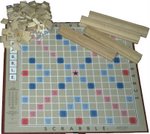
After coffee often my father would pronounce, “I am the greatest!”—a claim borrowed from the great fighter Mohammed Ali. The proper response to this (if you had any guts at all) was to confidently proclaim, “No, I am the greatest!” And then the Scrabble board would be hauled out, and all who were willing would play.

My Dad’s Scrabble strength was 7-letter words, which he often took many long minutes to produce. Patience was a virtue during these games. My Mom’s strength was diabolical, tightly interlaced plays leveraging triple-word or triple-letter scores, never leaving openings. House rules were that you could not play a word unless you could clearly define it from memory.

Close to the dining room table in the Sugar Lane house was a hutch, and on the hutch were some nice pieces of glassware, various fishing memorabilia of my Dad’s, an old German mug brought home from Europe after the war. Our gray cat Shadow would sit on the hutch gazing alertly at the Scrabble board as if he were formulating his own play, and would occasionally reach out his paw and quietly lay it on the shoulder of the person sitting with his back to the hutch, as though to offer some form of support during difficult moments. Also on the hutch was a collection of windup toys from past Christmas stockings, ranging from pink plastic pigs to green spotted frogs to little shuffling red sneakers. To liven things up, especially if Dad was taking forever with a 7-letter word, we would wind up the toys and get them going all at once, hopping and shuffling and lurching across the table, and then laugh uproariously when my Dad looked at us askance over his glasses.

When my sister got married at the house one year and her wedding cake was sitting on the supper table, a windup frog ended up decorating the cake and I remember laughing about this so hard I got tears in my eyes. I’m not sure what the groom’s family made of this.

I have tried to encourage the supper table tradition with my own family, and am thrilled and happy when it ends up working out. It brings back some good memories.

Monday, February 18, 2008

Summer of Love

In the full, humid heat of an Indiana July in 1967, my parents packed the family into our light blue station wagon for a road trip headed west. I was thirteen years old. In those days, smoking was acceptable everywhere, even on long-distance car trips, but there was no air conditioning, so the windows were open to make up for it and all we had to do was dodge the burning ashes as they flew out the front windows and back into the rear ones.

Since there were no DVD/CD players, video games, or even reliable radio reception for miles at a time, we took along story books, comic books, crossword puzzles, and notebooks for journaling. We sang songs like “Tell Me Why,” and “Ezekiel Cried Dem Dry Bones.”

We played word games: Twenty Questions and a game called Hink Pink. In Hink Pink, you think of a noun and a modifier that rhyme, provide a definition as the hint, and players guess what the hink pink is. If the rhyming words have multiple syllables (and certainly all the syllables must rhyme), then you provide this hint when you describe your hink pink at the beginning of the game. You might say: “I have a hink pink that is an “obese rodent.” And the solution would be: fat rat. If you, perchance, had a multi-syllabic puzzle you might say, “I have a hinky pinky that means “crazy horse,” and the answer would be “silly filly.” Or a hinkety pinkety that is a “complimentary sparse distribution,” the answer being: flattering smattering. Or a hinketity pinketity that…but I leave this last one as an exercise for the reader. (If you have a really good hink pink that must be shared, leave it in a comment below.)

Thus we somehow managed to amuse ourselves for entire days of travel and restrain from driving each other insane to some degree, although this is easier for me to say because I squirreled myself as far away as possible in the rearmost compartment of the light blue station wagon, and the three siblings including my manic brother and two younger sisters were confined together in the middle seat. (In another example of how we did things differently back then, we never wore seatbelts; if we had been rear-ended I would have been mooshed like a little sardine.) But we managed to avoid for the most part the dreaded moment when my father would slow down and yell, “Don’t make me stop this car!”

Toward evening the kids would start begging for the ultimate treat, a motel with a Swimming Pool. No reservations were made ahead of time so often our exhausted father, faced with motels that had orange neon “no vacancy” signs or were so exceedingly seedy that we couldn’t stomach them, or did not have swimming pools, would drive much farther than planned to get us to the tiny motel room next to the big pool. After checking in, the next move was always cannonballs into the pool to work off all the unexpended energy from a long day of travel.

We passed through Reno on our way to the West Coast, with its exotically dressed ladies and noisy casinos that did not allow minors inside. My father was skilled at winning motel money in poker games. As another example of “things you wouldn’t do nowadays,” Dad handed me a twenty and told me to take the kids and find something to eat while he and Mom gambled for awhile. So I did that, and then the kids and I got distracted by a more accessible area with nickel slots, and not knowing that this was off limits for minors, I pumped a nickel into the nearest one. Suddenly, lights were flashing, bells were ringing and an alarmed woman was hustling the four of us out of the area. My chastened mother came to claim my winnings of about $40 in nickels, which to me back then seemed like quite a bit of dough.

We finally made it all the way to Fisherman’s Wharf in San Franciso, where people that some called hippies were thronging in large numbers, wearing colorful tie-died clothing, peace symbols and headbands, burning lots of incense and other stuff. Guys had hair as long, if not longer, than mine, which was down to my waist back then. People were handing out subversive literature, with ideas I had never, ever heard before and shocking pictures of sexual activity that caused my Mom to blush and pull the papers out of my hand, discarding them with amused horror. There were colorful posters with imagery that was said to be psychedelic, and something called flower power. We had arrived just in time for the Summer of Love. On Fisherman’s Wharf I put my nickels to good use and bought myself a dark brown leather hat with a floppy brim, which my father immediately dubbed my “Go to Hell Hat” for reasons I didn’t fully understand. I wore this hat constantly for the rest of the trip.

As we drove down The Big Sur, Highway 1 was lined with hundreds of hippies, all hitchhiking. In yet another example of things you would never do nowadays, my Dad picked up one of these hitchhikers and peppered him with friendly questions about how he had come to be on the road, where he was headed, what he believes. There was discussion of the need for peace and love, there was concern for something called the draft, and about a war that was raging in a place called Vietnam. The fellow was very good-natured and forthcoming with these questions, and thanked us politely as we dropped him off near the campground that was his destination.

That trip West was quite an adventure, and as we were passing through Terre Haute on the final stretch of our travels back home to our little conservative God-fearing rural Indiana hometown of Ellettsville, I had an epiphany, inspired by pondering the many strange hypocrisies and contradictions of a small town where most folks go to church every Sunday but full blown vandalism in the form of soaped windows, TP’ed trees and corn thrown against picture windows occurs every October 31st.

As a result of the ephiphany I actually made up a song, lyrics and music, wholly out of thin air, with guitar accompaniement. That autumn I won second prize singing this song at the annual Fall Festival. It was quite a hit because it was about sports, based on a cheer we used to do at ballgames. It is one of three songs I ever composed, and its lyrics are now immortalized in this blog as follows:


Ellettsville

I come from E-double-L-E-double-T-S-V-I-double-L-E.
A riot every Halloween and a church on every street.
I said E-double-L-E-double-T-S-V-I-double-L-E.
Our high school ain’t got long-haired kids
And we don’t take LSD.

Well I was born in Hoosier town
I lived there many a year.
I went to their schools and their basketball games
And I learned all their cheers.
But just one cheer stands out so clear
It’ll always be with me.
It’s E-double-L-E-double-T-S-V-I-double-L-E.

Well it’s football in the early fall
And winter brings basketball.
In summer there is baseball
For the guys who ain’t heavy or tall.
But through it all I can hear that call,
It’ll always be with me.
It’s E-double-L-E-double-T-S-V-I-double-L-E.

I said, E-double-L-E-double-T-S-V-I-double-L-E.
A riot every Halloween and a church on every street.
I said E-double-L-E-double-T-S-V-I-double-L-E.
Our high school ain’t got long-haired kids
And we don’t take LSD.

There is a game played overseas
Without a ball or goal.
And guys who go to play that game
Are playin’ with their souls.
I’ve often wondered how the hometown boys
Will bring home victory
Without that cheer to pull them through
Without their parents tried and true
To yell E-double-L-E-double-T-S-V-I-double-L-E.

I said, E-double-L-E-double-T-S-V-I-double-L-E.
A riot every Halloween and a church on every street.
I said E-double-L-E-double-T-S-V-I-double-L-E.
Our high school ain’t got long-haired kids
And we never faced defeat.
Ellettsville...Ellettsville.